


It starts small. A shimmer at the edge of your vision, maybe, or a neck that feels tight for no reason. By lunch, the office lights seem to be aimed straight at your eyes. You close the blinds, then the door. That dinner with friends tonight? You type a quick apology and hope nobody asks for details.
If you live with migraines, you know the rest. The pain is only one part. There are the cancelled plans, the unfinished work, and the quiet worry that the next attack is already on its way.
Maybe you have tried pills. Maybe they help, but not enough, or they leave you foggy. So you start to wonder about acupuncture for migraines. Does it work, or is it just a hopeful story people pass around?
This guide gives you a straight answer. You’ll see what research says, what treatment is like, and what results are realistic. We’ll also cover safety, when to see a doctor first, and how to find care in Guaymas, Sonora.
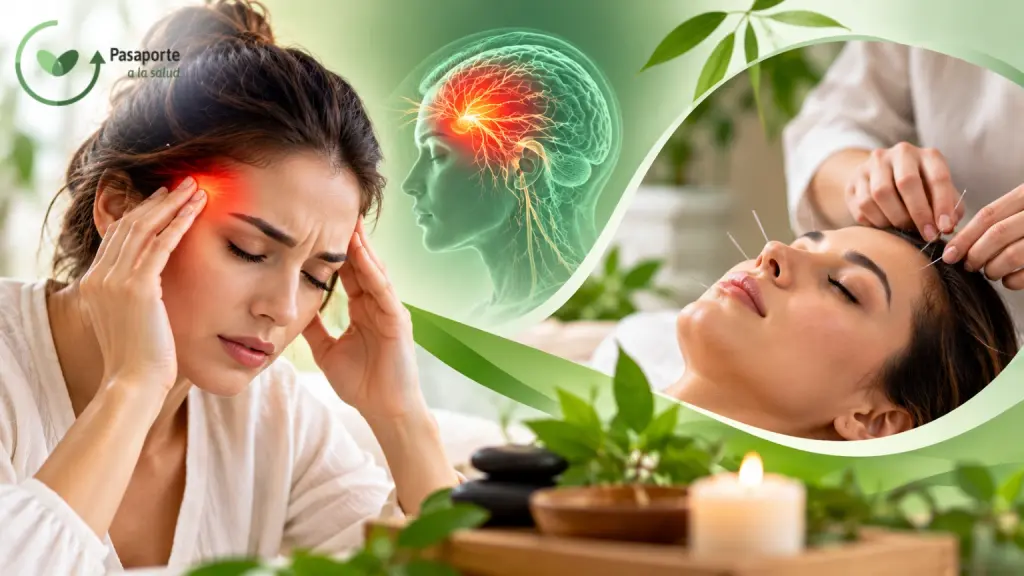
Can Acupuncture for Migraines Actually Help?
The short answer:for many people, it may. But it isn’t a sure thing, and it isn’t a cure.
Start with the strongest evidence. In 2016, a group called Cochrane combined 22 trials with 4,985 people who had episodic migraine, meaning attacks on fewer than 15 days a month. People who got acupuncture had fewer headache days than people who got none. About 41 in every 100 of them cut their attacks at least in half. Without acupuncture, it was 17 in 100.
Against fake (sham) acupuncture, the real thing still came out ahead, but only by a small amount. Against preventive medicine, acupuncture did about as well, with fewer side effects.
Now the plain part. The U.S. National Center for Complementary and Integrative Health (NCCIH) says some of the benefit may come from expectation and the placebo effect, not only the needles. That doesn’t make your relief imaginary. It does mean nobody can promise you a result. People respond differently. Some see attacks drop a lot. Some notice very little.
This table shows where the evidence is stronger and where it is thin.
| What researchers have studied | What the evidence suggests | How solid it is |
| Migraine frequency (how many attacks you get) | Possible reduction | Best supported, moderate-quality evidence |
| Migraine intensity (how strong the pain is) | Possible improvement | Promising, but results vary |
| Duration of attacks | Some studies report improvement | Limited. Fewer studies look at this |
| Quality of life | Some evidence of benefit | Promising, but less consistent |
| Long-term effects | More research is needed | Some benefit seen up to a year in pain studies, but not settled |
How Does Acupuncture for Migraine Work?
There are two ways to explain it.
In traditional Chinese medicine, the body has channels that carry energy, and needles along those channels restore balance. That’s the tradition behind the work at Pasaporte a la Salud. Modern researchers use things they can measure.
How Acupuncture May Affect Pain Pathways
Think of pain as a message. A nerve sends it to your spinal cord and brain, and your brain decides how loud to make it. Needles stimulate nerves in the skin and muscle underneath. Researchers think this may change how pain signals are handled, turning the volume down a little. Some brain-scan studies point that way, though nothing is settled.
Needling may also loosen tight neck and shoulder muscles, and lying still in a quiet room may help a stressed body settle. Neither idea is proven.
Why Migraine Treatment May Involve More Than the Head
Migraines rarely show up alone. Many people also have a stiff neck, poor sleep, skipped meals, or heavy stress before an attack. A good practitioner asks about all of it.
Points are chosen for you, not from a fixed list. GB20, at the base of the skull, and LI4, between the thumb and index finger, are often used for head pain, but yours could differ. You may also get advice on food, sleep, or massage.
What Can Acupuncture Help With During a Migraine?
● Migraine pain and intensity
Some studies show lower pain scores after acupuncture. But most trials tracked change over weeks, not minutes, so don’t expect needles to switch off an attack that is already roaring. If a medicine works for you during an attack, keep using it as your doctor advises.
● Frequency of migraine attacks
This is where the research is strongest. Frequency simply means how many attacks you get in a month. If that number drops, you lose fewer days, cancel fewer plans, and may need fewer pain pills. That matters, because taking pain medicine too often can bring on rebound headaches of its own.
● Headache-related symptoms
A migraine is more than a bad headache. The pain often throbs and often sits on one side. Nausea and sensitivity to light and sound are common. An attack can last anywhere from 4 hours to 3 days. About 1 in 4 people also get an aura first, such as flashing lights or zigzag lines.
A tension headache feels different: a dull, tight band of pressure on both sides, usually without nausea.Acupuncture for headaches has been studied for both types, though the migraine research is stronger. Not sure which you have? Sort that out with a doctor. Research on nausea or light sensitivity alone is thin, so we won’t promise anything there.

What Happens During Acupuncture Treatment for Migraines?
Not knowing what to expect keeps many people from booking, so here’s a walk-through.
Your First Acupuncture Visit
A first migraine acupuncture visit is mostly about listening. Every practitioner works a little differently, so call the clinic to confirm the details. In general, it goes like this:
1. You talk through your symptoms and health history, including medicines and allergies.
2. You describe your migraine pattern: how often, how long, and how strong.
3. You go over possible triggers and other symptoms, like neck pain or trouble sleeping.
4. The practitioner builds a plan from what you’ve said.
5. The needles go in, and you rest.
6. You talk about how you feel and what to watch for before the next visit.
The practitioner may also use other methods from Chinese medicine, such as cupping, gentle electrical stimulation, or massage. The clinic’s patient form lists these as possible options.
What Does Acupuncture Feel Like?
The needles are hair-thin, much finer than the ones used for shots. Many people feel a quick pinch as one goes in. Some feel nothing. Once it’s in, you might notice a dull ache, warmth, heaviness, or a mild tingle. That’s normal. Sharp or burning pain is not, so speak up, and the practitioner can adjust it.
Then you lie still, often for 20 to 30 minutes. Some people doze off. Afterward, you may feel relaxed or a little tired, and a small bruise or sore spot can show up. It doesn’t hurt everyone, and it isn’t painless for everyone either, but many find it gentler than they feared.
How Many Acupuncture Sessions Might You Need for Migraines?
There is no single number, and be careful of anyone who hands you one right away. Acupuncture migraine treatment is rarely a one-visit fix.
Why there isn’t one number for everyone
Several things shape it: how often your migraines come, what your pattern is, how long you’ve had them, your other health issues, and how your body responds. Two attacks a month for a year is a different starting point than weekly attacks for twenty years.
Every trial in the Cochrane review ran at least eight weeks, so change, if it comes, is likely to be gradual. The clinic’s own website says long-standing problems such as migraines may take four to ten treatments before you notice a significant change. Treat that as a general guide, not a promise.
One patient shared their story on the clinic’s site. They had lived with migraines since childhood and had once been rushed to the hospital for one, where treatment didn’t work. After about five months of acupuncture, deep massage therapy, and better nutrition, they wrote that the problem was solved. That’s one person’s account, and it involved more than needles. Yours may go differently.
Tracking your migraine symptoms
The best tool you have is a simple diary. Mayo Clinic suggests keeping a record of your attacks and how you treated them. It shows you and your practitioner whether things are really changing, because pain is hard to remember accurately.
| Track this | Why it matters |
| Number of attacks | Shows frequency |
| Duration | Shows how long attacks last |
| Pain intensity | Helps compare changes |
| Possible triggers | Helps identify patterns |
| Sleep | May reveal useful patterns |
| Medication use | Helps track overall management |
A notebook works fine. Two or three lines after each attack is enough.
Acupuncture for Migraines vs. Other Migraine Treatments
Acupuncture doesn’t replace everything else. It’s one tool among several.
Migraine medicines come in two groups.
- Some are taken at the start of an attack, like pain relievers and anti-nausea drugs.
- Others are taken daily to prevent attacks.
Both can work well, and both cause side effects for some people. In studies that compared them with preventive drugs, acupuncture did about as well or slightly better, and fewer people quit because of side effects. Still, those studies were small, and your doctor may know why a certain drug suits you.
Relaxation training, biofeedback, and steady habits like regular sleep and meals also have some support.
Many people add acupuncture to their usual care. If you take prescribed medicine, don’t stop or change it on your own. Tell both your doctor and your acupuncturist what you’re doing.
Is Acupuncture Safe for Migraines?
The NCCIH says acupuncture is generally considered safe when an experienced practitioner uses sterile needles. The usual problems are small: some soreness, a tiny bruise, a bit of tiredness. Serious problems, such as infection, are rare, but they can happen when it’s done badly. So who holds the needles matters.
Before you book, ask whether the practitioner is licensed and uses new sterile needles for every patient. Tell them if you’re pregnant, take blood thinners, or have a pacemaker. At Pasaporte a la Salud, Richard Smithee holds a master’s degree in Traditional Oriental Medicine from Pacific College of Oriental Medicine in San Diego and a license from the Secretaría de Salud Sonora, per the clinic’s website.
When to See a Doctor First
Some headaches are warning signs, and they need medical care, not needles. Mayo Clinic says to get help right away, or go to an emergency room, if you have:
• A sudden, very bad headache, like a thunderclap
• A headache after a head injury
• A headache with fever, stiff neck, confusion, weakness, numbness, or trouble speaking
• A headache that gets worse when you cough, strain, or move suddenly
• New headache pain after age 50
See a doctor too if your pattern changes or your headaches suddenly feel different. And if you’ve never had a diagnosis, get one first, so acupuncture becomes part of a plan instead of a guess.
Looking for Migraine Acupuncture in Guaymas, Sonora?
If you live in Guaymas, you don’t have to go far. Pasaporte a la Salud is at Blvd. Sánchez Taboada #706, Colonia San Gilberto. If you’re coming from San Carlos, Empalme, or Hermosillo, plan around clinic hours.
Hours are Monday, Tuesday, and Friday from 9:00 to 12:00 and 3:00 to 6:00, and Saturday from 9:00 to 1:00. To ask questions or book, call the clinic at 52-622-224-3255 or the Mexico mobile line at 52-622-142-0042. You can also write to info@pasaportealasalud.com. Bring your diary and a list of your medicines.
So, can acupuncture for migraines help? The research says it may, mostly by cutting how often attacks come, and it seems gentler on the body than many drugs. It isn’t a cure, and results differ. Realistic hopes, a diary, and your doctor in the loop give you the best shot at finding out if it works for you.
If you’d like to try it in Guaymas, call the clinic and ask your questions first. You shouldn’t have to plan your life around the next attack.


