

You wake up tense. Your jaw is already clenched before you’ve even had your first cup of coffee. By midday, that same subtle sense of anxiety returns, settling in your chest like a stone. You’ve tried deep breathing. You’ve tried ignoring it. Nothing works.
Chronic stress is not an attitude problem; it is a physiological issue. In fact, anxiety disorders currently affect some 301 million people worldwide—a 55% increase since 1990.
Most guides simply recommend breathing exercises and journaling. This article goes further: it examines how natural stress treatments—such as Traditional Chinese Medicine (TCM), acupuncture, and Tai Chi—modulate the nervous system, backed by real clinical evidence and practical options, whether you are in Sonora or anywhere else in Latin America.
Anxiety and Stress Treatment Begins with Understanding the Nervous System
The Problem: Your Body Doesn’t Distinguish Between Real Danger and a Deadline
When you are under pressure, the hypothalamic-pituitary-adrenal (HPA) axis floods your body with cortisol. Your heart rate rises, digestion slows down, and your muscles prepare to flee from a threat that is not, in reality, physical.
The problem is that modern threats never fully go away. Work-related stress, financial worries, and relationship tensions keep the HPA axis constantly active. Cortisol levels remain elevated, and over time, this wreaks havoc: insomnia, digestive issues, emotional volatility, and immune system suppression.
This is where anxiety and stress treatments based solely on pharmaceutical approaches often fall short, as they alleviate symptoms but do not retrain the nervous system.
The Solution: Stimulate and Modulate, Not Suppress
Traditional Chinese Medicine (TCM) takes a different approach. Rather than simply suppressing the stress response, TCM techniques stimulate specific physiological pathways to restore balance to the nervous system.
Acupuncture, in particular, activates the parasympathetic nervous system—which governs rest-and-digest processes, as opposed to the fight-or-flight state. Clinical studies confirm that needle stimulation triggers the release of endorphins from the pituitary gland and measurably reduces cortisol levels starting from the very first session.
Clinical note: This is not merely anecdotal. It is demonstrable neuroscience, backed by over three decades of clinical evidence from medical institutions across Asia, Europe, and North America.
What Really Happens During an Acupuncture Clinic Session
The First Visit: A Comprehensive Evaluation, Not Just a Treatment
Many patients arrive expecting a standard 60-minute appointment. However, the initial consultation at our acupuncture clinic lasts between one and two hours (60 to 120 minutes) because it begins with a comprehensive assessment.
During this initial session, the specialist evaluates the color and shape of the tongue, the pulse quality at three positions on each wrist, emotional patterns, sleep quality, digestion, and the distribution of physical pain. This diagnostic map reveals which organ systems are under stress, where Qi (vital energy) is stagnant, and which meridians require stimulation. Only after this analysis are the needles inserted.
Key Points for Stress and Emotional Regulation
To address stress and emotional imbalance, a combination of strategic points is typically used:
- Governing Vessel 20 (GV20: Bai Hui): Located at the crown of the head, it calms the Shen (spirit) and is one of the most frequently used points to alleviate anxiety and clear the mind.
- Pericardium 6 (PC6: Nei Guan): Located on the inner wrist, it helps regulate heart rhythm and reduce nausea caused by anxiety.
- Heart 7 (HT7: Shen Men): Known as the “Spirit Gate,” it is used specifically to combat insomnia, restlessness, and emotional agitation.
- Liver 3 (LR3: Tai Chong): Relieves Liver Qi stagnation—the TCM pattern most closely associated with chronic frustration, irritability, and tension headaches.
The needles used are extremely fine and sterile. Most people describe the sensation as mild pressure or warmth, and it is not unusual for patients to fall into a deep sleep during the treatment.
Ready to get started? Patients from Guaymas, San Carlos, Empalme, and Hermosillo come to our clinic in Sonora for personalized sessions. Book your first consultation at pasaportealasalud.com.
Tai Chi and Qi Gong: Natural Treatment for Anxiety and Stress from Anywhere
The Power of Conscious Movement
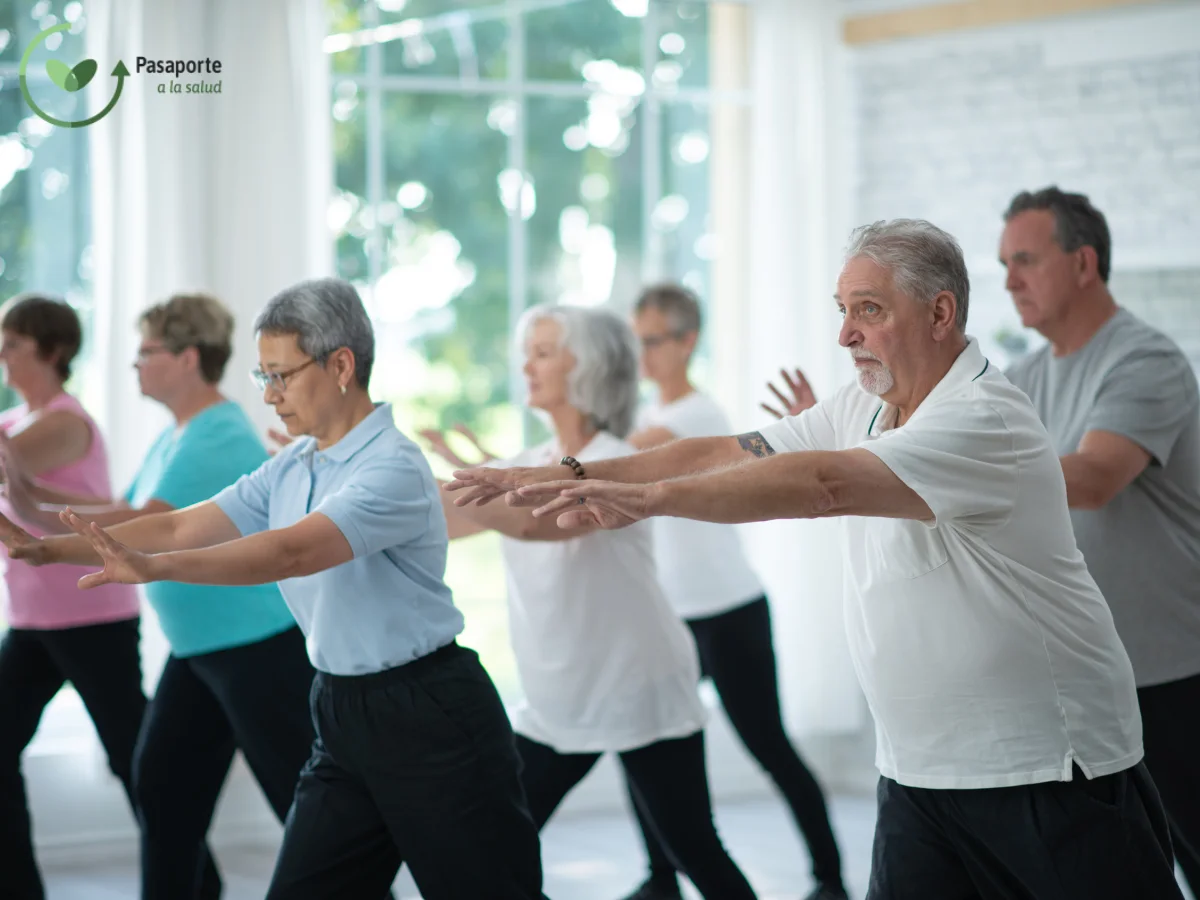
Tai Chi is not a conventional exercise. It is a moving meditation that coordinates breathing, intention, and body alignment to stimulate the circulation of Qi and regulate autonomic nervous system tone. From a neurological perspective, the continuous, unhurried practice of Tai Chi activates the parasympathetic nervous system and helps to progressively lower cortisol spikes naturally.
Online Classes for All of Latin America
Residing in Sonora is not required to benefit from these disciplines. Patients from across Latin America (from Mexico City to Buenos Aires) access our structured virtual classes via pasaportealasalud.com.
For its part, Qigong (the aspect more focused on meditation) employs breathing sequences and static or gentle postures to restore the connection between breathing and emotions. For those experiencing chest tightness or shortness of breath due to anxiety, Qigong is often the first therapeutic recommendation. Both methods are suitable for all ages and carry no risk of side effects or dependency.
Which TCM Therapy Is Best Suited to You?
| Therapy | Delivery Format | Session Duration | Ideal for | Available online? |
| Acupuncture | In-person (Clinic) | 60–120 min (1st session) | Acute stress, anxiety, insomnia; support for gastritis and diabetes | No (requires physical application) |
| Tai Chi | In-person or Virtual | 45–60 min per class | Chronic stress, emotional regulation, balance, and mobility | Yes, through online programs. |
| Qigong | In-person or Virtual | 30–60 min per session | Energy regulation, respiratory calm, and immune strengthening | Yes, through online programs. |
| TCM Herbal Medicine Consultation | In-person or Teleconsultation | 60 min (initial) | Systemic imbalances, emotional fatigue, and digestive problems. | Yes, available remotely. |
Natural Treatment for Gastritis and Diabetes via TCM: The Connection to Stress
Stress does not remain solely in the mind; it manifests directly in the body. Two of the most common physical consequences we treat at our clinic are stress-induced gastritis and metabolic imbalances.
Natural Treatment for Gastritis: Calming the Stomach-Stress Axis
In TCM, the Stomach and Spleen meridians govern digestive function. When Liver Qi stagnates due to chronic stress, it “invades” the Stomach channel, causing acid reflux, nausea, abdominal distension, and inflammation—symptoms characteristic of clinical gastritis.
The application of acupuncture at points such as Stomach 36 (ST36: Zu San Li) and Conception Vessel 12 (CV12: Zhong Wan) is clinically supported for its ability to regulate gastric motility and protect the mucosa. By addressing the underlying stress pattern, this natural treatment for gastritis allows digestive inflammation to subside at its very root.
Natural Treatment for Diabetes: How Stress Affects Insulin
Cortisol directly raises blood glucose levels. For patients with type 2 diabetes or prediabetes, chronic stress acts as an active metabolic destabilizer.
The TCM approach to treating diabetes naturally combines acupuncture (stimulating the Kidney, Spleen, and Pancreas meridians) with Qi Gong practice to regulate cortisol production, alongside personalized herbal formulas. This method does not replace allopathic medical treatment but rather complements it by addressing nervous system factors that medications do not cover.
Frequently Asked Questions
Is acupuncture effective for stress and anxiety?
Yes. A 2022 review analyzing 27 randomized controlled trials with a total of 1,782 participants (cited by the U.S. National Center for Complementary and Integrative Health, NCCIH) concluded that acupuncture reduces anxiety symptoms significantly more effectively than control treatments in patients with generalized anxiety disorder.
How many acupuncture sessions are needed to notice relief?
Most people notice significant improvements between the third and fifth sessions. Acute stress conditions may respond even more quickly, whereas chronic cases—accompanied by insomnia or digestive issues—typically require a structured cycle of 8 to 12 sessions.
What is the difference between Tai Chi and Qigong for stress?
Qigong focuses on repetitive individual movements and simple breathing techniques to cultivate energy, making it ideal for beginners or those experiencing fatigue. Tai Chi consists of longer, choreographed sequences that also enhance coordination, physical balance, and long-term emotional resilience.
Can I receive TCM treatment if I live outside of Mexico?
Yes. Although acupuncture requires in-person visits, traditional herbal medicine consultations, health assessments, and Tai Chi and Qi Gong programs are conducted with full effectiveness online for patients across Latin America.
Is TCM safe alongside medical treatment for diabetes or gastritis?
Absolutely. TCM is designed to be integrated in a complementary way. It does not interfere with your prescribed medications; instead, it helps by reducing the stress load that exacerbates both conditions.
Your Nervous System Can Be Retrained
Remember these three key points:
- Chronic stress is a real physiological pattern—not a personal weakness—and responds precisely to TCM intervention.
- Acupuncture stimulates specific points along the meridians to measurably reduce cortisol, achieving a direct physiological impact.
- Access to these therapies is available in person in Sonora (for residents of Hermosillo, Guaymas, San Carlos, or Empalme) and virtually for the rest of Latin America.
Take the next step toward your well-being:
- If you are in Sonora, schedule your appointment by calling our clinic directly at 622-224-3255 or 622-142-0042.
- If you are out of state or country, visit passportalasalud.com to learn about our virtual programs and book your initial evaluation teleconsultation.


